The most optimistic outcome of generative AI leaves us with a technology that warps our perception of reality and crushes labor. The most pessimistic destroys all of humanity.
Our CEOs not only insist we genuflect before these machines but measure our sacrifice and shame our reluctance.
That requires abolishing capitalism, and since these AIs are going to hyper-empower the already powerful capitalist ruling class, that utopian outcome seems unfortunately extremely unlikely.
Feeding ever more amazing technology and science into a broken social/political/economic system does not result in a better world unfortunately.
How does that coexist with Capitalism? I just don't see a path.
Regardless of where you fall on the alignment chart, if you are looking backwards from now to the industrial revolution, it's pretty easy to make the claim that from a standpoint of pure technological progress (discounting all other things, like quality of life, environmental impact, etc) that capitalism "won". But going forward, if the need for labor is completely crushed, and capital continues to get concentrated into the hands of the elites, I just don't see how that is viable long term. It seems like for things to shift to the world Keynes (wrongly) predicted, where we all have abundance of leisure time, then there's a massive distribution of the fruits of automation into the hands of the masses, which needs to be controlled by an entity who does not purely exist to acquire more capital, which is sort of the end of capitalism as we know it.
Or maybe AI kills us all before we get there, who knows.
I’ve been on a SSRI for 5 years and not once have I thought about getting off of it. It literally saved my life.
I remember a while life of depression and constant churn of recursive emotions destroying me.
I’m worried that too many people are downplaying the benefits that this drug for those of us that it has helped immensely. And it’s extra risky to be downplaying it while RFK jr is actively working to remove the drugs from the market.
An unfortunate aspect of modern discourse and thinking is how black and white discussions can feel. Several sides of the topic can co-exist together and all be true, so (well, in my experience and reading):
- Some people really benefit from and even need SSRIs or other psychoactive drugs to function well in society.
- Too many people are prescribed them such that there may be more harm than good. They may have side effects or were prescribed them to deal with a situational problem that could have been better managed with therapy.
- Whether justified or no, a prescription is given with no off ramp provided. It's almost as if you're defective and the drug is fixing you, and the solution are pharmaceuticals, which again may be true for some subset of those prescribed. People clearly are trying to taper and are suffering.
More controversially, psychiatry is something of an art (if you're generous) or a racket. Because there's no way the "chemical imbalance in the brain" theory can be validated empirically. In the US you meet with one for 15m, get prescribed a cocktail of drugs, a few months later you report if it worked, and if not they'll up the dose or play around with the cocktail. I don't know how we call that stuff science.
> In the US you meet with one for 15m, get prescribed a cocktail of drugs, a few months later you report if it worked, and if not they'll up the dose or play around with the cocktail. I don't know how we call that stuff science.
Is that not science? It's on a small scale but this is all they have to work on. We don't understand enough, it is all trial and error.
I note that not all psychs operate this way, mine would not give me a perscription until several visits in.
Well, it's science if you consider the patient to be the subject of an experiment. But the point I was trying to make is - they don't directly measure serotonin or anything else in the brain. They can't see thoughts through a machine or measure 'chemical balance', whatever that is. They leave it to correlation - give drug, report result given by patient. It's like nutritional science, but even worse, because at least with nutritional science you can measure blood sugar or cholesterol. Psychology involves the outside world - relationships, financial security, social stresses, physical health, etc. Habits of mind. Traumas. So much more.
I think the issue is informed consent. If people find benefit in them by all means they should be able to take them. But currently these drugs are being given out for the most mundane issues, many of them temporary, after a 2 minute visit with a Primary Provider/GP, with little to no discussion on potentially permanent and serious effects, whether that be long term withdrawal or the equally life ruining PSSD. Neither of which seem to be particularly rare given the number of prescriptions.
I’m happy for your extreme good response to the drug. I’ve witnessed this type of response in my close circle once, and it is life saving medication in these situations.
I think it’s important to highlight that not every person has the same response to these medications. I think it’s absolutely something anyone struggling with depression should try, but there should be expectations about how long to stay on a medication before moving on.
> I’ve been on a SSRI for 5 years and not once have I thought about getting off of it.
I had this same outlook too. Was on one for about 6 years and then my first kid was born. I felt nothing emotionally when she came in to the world and I discussed this with my wife. Two years later, my second child was born and it was a radically different experience and I am glad I got off.
My GP warned me, "Don't cold turkey it, taper off, cut the dosage and ween off. Ask your wife to pay attention to your moods, if you go sour and can't recover, you may want to consider going back on."
Over those 6 years on it, I learned a lot about how to deal with the stress. I definitely think that's a missing key in the whole treatment process.
Chronic depression doesn't usually have a "cause" that you can fix without some form of treatment. It happens that these meds often do remove the extreme effects of depression and allow you to focus on other problems.
I have first hand experience. Also "depression" is different from "chronic depression". You can experience the former as the direct result of some cause.
Come on. Don’t roll into a conversation playing armchair expert criticizing others’ contributions when you’ve got nothing of substance to say.
You’re as capable of typing “causes of chronic depression” into a search bar as anyone else. The fact that you don’t do that indicates you don’t want to contribute. You just want to be argumentative.
There's situational depression (my mom died, my girlfriend dumped me, etc.) and then there's depression. Winston Churchill called his The Black Dog. It is relentless and not related to any situation you are in. If you don't understand then be thankful.
The cause is not entirely clear. SSRIs do not help you "bury it." It's not an emotional problem or a lifestyle problem or anything like that. There's no "it" to bury. SSRIs seem to remove whatever cause is in your brain/nervous system. They literally are lifesaving drugs with almost no side effects for many people!
If it comforts you to believe that depression always has a discernable cause that can be fixed without medication then go ahead and keep believing that.
This particular comment about Churchill and your dismissal of the experience of many depressed people sounds pretty spiteful to me (to borrow your diagnosis). Maybe some self examination could help you
I wonder if you feel the same about drug-based treatments for multiple sclerosis or ALS. Or hormone replacement therapy. Or palliative end of life care.
Sometimes treating symptoms is what we can do because we don’t have a cure.
Then don’t ask about whether the drugs cure the disease or just “bury it further”.
Own your opinion and state clearly that you don’t believe depression is real. Don’t argue silly tangents that serve only to obfuscate your actual point.
What might the difference between between ADHD and ALS though? One is a neurodegenerative disorder and the other is indiscernible from some ditsy airhead who can't be bothered to do things
See how freeing that is? You can just be honest about your beliefs and others can choose to engage or not based on that instead of playing some silly game of pretending that treating symptoms is a bad thing.
It’s ironic that the current secretary of health believes that medicines like SSRIs are overprescribed while simultaneously believing that TRT is underprescribed. It’s interesting to see how people can accept their own “treat the symptoms” medicine as appropriate but deny others. Especially when the primary symptom of low T that most attest is lack of energy and motivation. Aka “can't be bothered to do things”.
It's nasty because of the assumption that someone who is taking medication has "buried the cause further", in other words, done something to paper over the rent in their psyche that could have been fixed some other way.
In my case, I had depression for no apparent reason, and I went through dynamic psychotherapy, which is basically about finding that reason. That failed, I got worse, and basically was disabled after a few years. I finally found a medication, venlafaxine, that actually worked. My depression abated, I was no longer disabled. It has well-known withdrawal effects, so I tapered off of it very gradually. When I stopped, I was no longer suffering major depression. There was no removal of any particular cause.
> In my case, I had depression for no apparent reason, and I went through dynamic psychotherapy, which is basically about finding that reason.
What was happening with you at that point, where were you at? Riding ecstatically high with your wife kids and large circle of friends, the constant socialising and good times?
I can see that there is no point in continuing this conversation. I wish you the best and that you may never experience depression with your wonderously, fabulously ecstatic life.
Ok, Freud. You’ve successfully diagnosed the cause of Churchill’s chronic depression. Now what?
What is your treatment given that you’ve identified the cause as a past childhood experience. You got a time machine? Or do you treat the disease in the present?
Actually, I’m a little worried by what this post demonstrates but not the logo or the use of the api.
I’m worried that switching apps and screenshots _doesn’t_ put the logo in. If the point of the switch is privacy, isn’t that a bug? Shouldn’t it apply the privacy screen during any screenshot? What if there was sensitive information on there when you were switching and taking the screenshot?
The issue will be "out of sight, out of mind" (or rather knowingly ignored) until the issue appears at scales as small as the home village, which in terms of the US government means the front and back yard of the white house or similar.
These people are living in parallel societies, where they are completely detached from the reality for many people living in the country. And that is not merely a problem in the US.
Nearly all of those are forests that are supposed to burn every year or two. Check with a forester knowledgeable in your specific area because there is no universal truth here. However the generalization that all forests in North America need to burn regularly for good health is true even though there are exceptions.
I am a small scale forester (hundreds to thousands of acres). Supposed to burn is ... complicated and not necessarily true. Many forests in the PNW have had indigenous Americans burn them regularly because it improves forest health. These fires were typically kept small and well maintained to avoid damage to the trees. White settlers put a stop to this practice, and natural fires were considerably less common than anthropogenic ones in some regions.
So it might be correct to say that fires can be healthy for forests, but "supposed to" is more difficult to assert.
I just finished limbing, brush clearing, and preparing burn piles from a section of my forest because removing fuel is good, but most forests in America are young planted forests. They have smaller trees, less diversity, higher than typical density, and small trees that can cause fires to climb to crowns (where they then become deleterious rather than helpful.)
If we were to return to indigenous practices of regular burning, we would likely see healthier forests. But I'm not sure we'd see as much timber production from them. Since that's what most forests are held for... I don't see practices moving away from trying to maximize timber while minimizing cost any time soon.
Thanks for that complexity. I've posted brought the same thing and all the responses have been "no, fire is bad" from people who obviously have no idea what they are talking about.
I'm standing by my claims. However understand that I am in no way contradicting anything you said.
All forests in the American west, barring a few relatively small parks, are new growth. Predominantly from settlers cutting them down.
Indigenous practices changed which trees grew, for instance the Gary oak was much more prevalent in areas they tended. But old growth was predominantly removed by settlers.
Nope. The woods in Oregon (Willamette Valley) and WA were planted and/or allowed to grow by settlers. There are true old growths along the coast and higher up the mountains.
If you want to specifically hike through the old-growth forests, Olympic Peninsula in WA is the best option.
Humans were modifying the Earth on the continent-wide scale long before the industrial age.
Yes, in the Wilamette Valley the indigenous folks maintained Gary Oaks and prevented other trees from growing there. This was open oak savannah, and when the settlers came in they took the land and turned it to agricultural land. What they couldn't plant on, they ignored, and other tree species moved in to land that was previously managed to grow Gary oaks.
I'm a PNW native, you don't need to tell me about the small sliver of old growth we still have in the Olympics.
> Yes, in the Wilamette Valley the indigenous folks maintained Gary Oaks and prevented other trees from growing there.
Yes, and that's a fancy way of saying "used periodic burns" to remove the vegetation to make the land more hospitable for grazers. Meaning more animals to hunt, this was arguably a form of agriculture and also served to reduce the risk of catastrophic wildfires.
> I'm a PNW native, you don't need to tell me about the small sliver of old growth we still have in the Olympics.
Then you should actually learn about the history, and not its Disneyified version.
I'm saying it doesn't matter. If the forest is getting the regular burning it needs anyway someone lighting an additional fire at a different time isn't going to make any difference.
Not that you shouldn't be careful, you can get yourself hurt in a natural fire (but it shouldn't be such a large fire that it kills you). Leave no trace should be your goal. Even if fire itself is something that doesn't matter, there are lots of other parts of leave no trace that that will also result in less fires.
It's pretty reasonable to think that a person-caused fire will be way worse than a natural fire, since the people ones will be distributed far closer to other people-things, like houses and other people.
It is important to keep the main issue clear. Failing to invest in renewables is an existential risk to humanity's future.
Permanently shutting all Datacenters (not just AI) saves us about 1 year.
also - 1 year is a lot, if we actually act diligently to stave the warming crisis and to prepare for some of the effects through changes to construction & infrastructure.
Still, I would agree that Data Centers are just one particular aspect of the struggle against global warming.
Ironically, we are also moving to more capable / faster models that use less power. DeepSeek V4 Flash 0731 is so extreme capable and comparability to a lot of models cheap to run.
We are seeing stuff like AMD buying Taalas, with their Llama 3 8B on a chip, being able to push 17.000 tokens / second.
People need to understand, that even AI companies do not like to build datacenters and the high energy needs. It cost them money and they are also looking at ways to develop better hardware / solutions that gives them more inference for cheaper (what means less power draw / heat generated).
Unfortunately, "more capable / faster models that use less power" will likely mean those models will be used in more places than ever before. LLMs on laptops, on tablets, on phones, on fridges, in your web browser. See the Jevons paradox.
I just tested out chatjimmy and a bit and it did some misinterpretation of my prompts, E.g. "write me a python script to generate insults for a name given by command line" had multiple of the same insult in the insult list, and it had a list of names like John and Jane instead of doing the obvious thing and making the name a variable. Not good code.
Climate change is real, caused by humans, and the fires were seeing are absolutely exacerbated by the effects of the climate.
However this is the _least_ on fire the world has been for a while because it's usually Asian and Africa that are rampantly burning and they're improving land management techniques enough that it's tamping down on the worst of the burns.
The statistics for the number of deaths from climate-based disasters is clear: fewer and fewer people are dying the richer the world becomes. In fact the decrease in deaths is very significant:
"Annual climate-disaster deaths averaged around 77,000 per year in the 1960s–70s, dropped to about 33,000/year in the 1980s–90s, and fell further to roughly 27,000/year in 2000–2019 even as the number of recorded climate disasters rose from about 1,171 to 3,656 to 6,641 across those same periods."
If you're optimising for human life, then "drill baby drill", as more energy = more wealth. More wealth = better infrastructure, health care, dealing with extreme weather conditions.
If you think about this in terms of systems... it's unsustainable. You'll eventually get to a point where the damage you've done requires a flow of wealth/energy that cannot be generated for everyone.
I'm assuming that we can drive our environment to that kind of state, maybe there's an upper limit on how bad the environment can get. I'm not a climate scientist and don't have the curiosity to look into if there's a limit to climate change.
1. Of course it is. That is how models are built. They are not always correct of course, but it's the best we have.
2. We need to choose the cheapest energy option at the time. If renewables are cheaper then great, but making the poor even poorer to make is rich people feel better is not a good solution.
3. The consequences of making the world poorer is more people will die from climate related disasters.
“midwit-pilled”? Is this a “How do you do, fellow kids” rhetorical ploy? You’ve got it backwards. The average American and European thinks the Earth will be destroyed in current year + 5 years, and modern sumptuary laws or ersatz-religious rituals around recycling or performative bicycling have a material impact on climatic fluctuations that take thousands of years.
If XKCD is your source, you’re not on the right side of the bell curve. Sorry, friend. It’s not your fault. It’s just cruel statistics to be average. We can smugly scoff at how religions exploited the gullible for their own empowerment, and yet be oblivious to how it’s happening to them. Wow, an eschatological crisis? Guess I better vote how I’m told and self-flagellate.
> The average American and European thinks the Earth will be destroyed in current year + 5 years
Midwit take, not evidenced whatsoever. Please cite a single source showing any substantial number of people who believe "the earth will be destroyed" within 5 years. Less than 20% of Americans even believe climate change will seriously negatively affect them personally within 50 years.
Or is this just lazy and dishonest shorthand for something like "believe we will encounter a higher rate of catastrophes?"
If so, you should be sure to lump in all those stupid emotional insurers who are also apparently under some eschatological spell that you're just too brilliant to be taken in by.
You could make an absolute fuck ton of money by insuring the areas that the stupid midwit cultist insurers think are uninsurable due to climate risk, you know. Literally just mountains of cash waiting to reward your brilliant contrarianism.
> If XKCD is your source
One little trick to claw your way up the curve of midwittery: when you encounter new information, look for the string "Source: " and then look up the text immediately following that. I provided the nearest thing to a picture-book that I could find, because exactly 0 people I've ever met with this attitude actually have the attention span to read even a single scientific paper, never mind a couple dozen or couple hundred. You are invited to defy the odds, find the backing sources, and dispute them directly.
It's kind of lucky for everyone that climate is mostly a perfect sliding scale, the more CO2 you avoid putting into the atmosphere the more heat capacity you'd avoid. So every bit helps. Many negative impacts of heat, like changing intense weather, biodiversity loss, and deaths to high heat also correspondingly change linearly with heat. So every bit is a literal victory, there's no major cutoff that we know of until things get really bad (which they might). What's your point?
Do you get angry at people for calling sea stars starfish? "They aren't fish they are echinoderms!"
Or perhaps you get angry at people who call light utility vehicles "trucks"?
Language evolves. People accept colloquial definitions. Wait until you learn about pencil lead, koala bears, dry cleaning, and peanuts. Windmill is absolutely acceptable if it's understood by people to mean wind turbine, which it is.
When you say that the Greens provide subsidies to coal, but this can be found on a quick search…
> The next fight is already brewing, over a Green push to accelerate the phase-out of coal-fired power generation in eastern Germany. In a draft resolution, seen by POLITICO, the party wants to bring the coal exit forward from 2038 to 2030, as is already the case for mining regions in the west of the country.
Like all such articles they present a LONG list of politicians with "we're committed to/promising to/... phase out coal". And then a statement or two by the executive that they're increasing coal usage because they have no choice.
The problem is that there is no option left BUT coal.
This mixes several different things into one causal puddle.
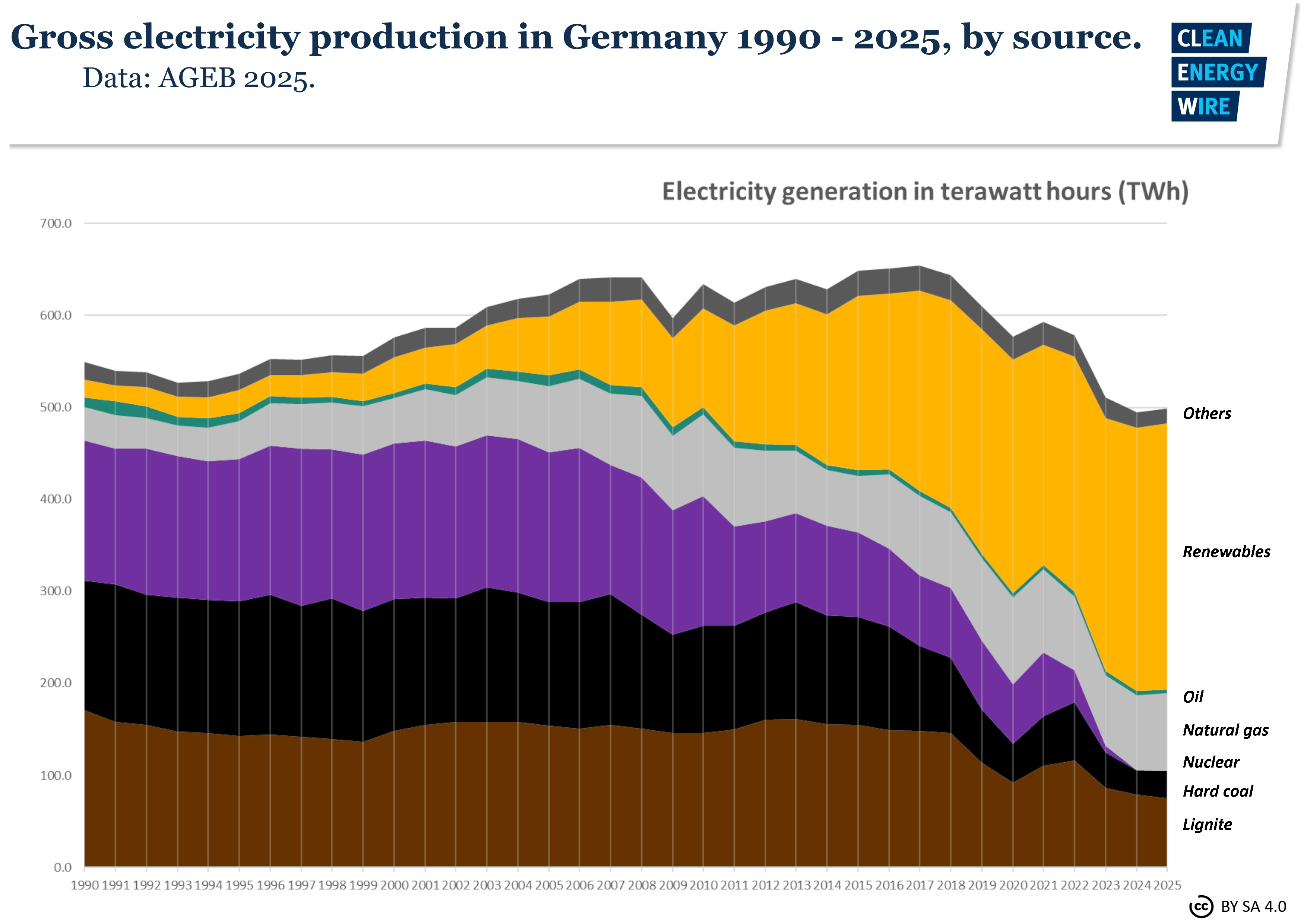
Yes, keeping the remaining nuclear plants running would have reduced emissions and electricity prices somewhat. A 2024 Energy Policy study estimates the 2022/23 extension lowered German wholesale prices by about €9/MWh. That's a real effect, but nowhere remotely close to "the nuclear phase-out doubled electricity prices." The huge price spike was primarily the European gas crisis. You know, the one for which LNG terminals had been built.
Nor did Germany replace nuclear with coal. Coal generation subsequently fell to levels not seen in decades, while renewables grew substantially, so German emissions fell as well.
Attributing the nuclear exit simply to "the Greens" is rather selective history. The original exit was SPD/Greens, but after reversing it in 2010, Merkel's CDU/FDP government legislated essentially the final phase-out schedule again in 2011. So basically: every party that was at the levers of power.
You could make a perfectly reasonable argument that shutting existing nuclear before coal was bad climate policy in hindsight, because of the gas crisis. But I don't think you need to resort to the rather dubious claim that it doubled electricity prices as a singular cause.
A better question is why Germany invested in gas power plants in the first place. Gas has always been the most expensive source of electricity, even before "the gas crisis" (how many of those have we had already?):
I get the idea that Germany would buy Russian gas in exchange for not having to spend on the military, but 2014 clearly showed that it didn't work. And Germany still doubled down on gas after 2022.
Now the argument seems to be that Germany will buy American gas so that it can get lower tariffs.
I don't see how Germany can compete with a China that refuses to reject the cheapest forms of energy, whatever that is (both nuclear and coal are cheaper than imported gas).
On July 9, 2026, the Bundestag passed Germany's new electricity-capacity law, which subsidizes reserve/dispatchable power capacity as coal is phased out. SPD and CDU/CSU voted for it; the Greens and Die Linke voted against it.
The Greens specifically argued against a long-term fossil-fuel lock-in, while Die Linke argued for renewables and batteries instead of subsidizing new fossil gas plants.
The law itself is primarily about new hydrogen-ready/gas-capable reserve plants, not coal plants.
The argument I think is that the share could be lower if the nuclear plants were kept running (broadly, based on your numbers, it could be less than 20% in 2025). Whether that would have made economic sense (especially in terms of redirections funds away from renewables), I am not so sure of.
The AGI’s conclusion will be simpler: humanity extinction. I am renovating my home and digging out the perimeter. Despite pavements being decades old I still find thrash buried around the house. Other houses in the neighborhood has the same problem. Relatives bought a villa near Bordeaux. Guess what, previous owners buries many cubic meters of asbestos under the entrance. AGI will not save few ones picking their litter for the majority of environmental pigs.


Our CEOs not only insist we genuflect before these machines but measure our sacrifice and shame our reluctance.
reply