This is a complete tangent, but is anyone else getting tired of the growing number of Svbtle blogs? They all blend together, with only the upper-left image to tell them apart - and sticking them all into the same circle makes those images all have the same silhouette.
The first appearance was cool, it was distinctive and unique. A breath of fresh air, even. But now it seems like a third of the links I hit from HN are Svbtlr blogs; it's starting to feel as generic and indistinguishable as last year's Wordpress theme.
'Scuse my tangent from your tangent, but this whole subtle [sic] thing seems like the clubhouse for the cool kids. I don't like the cool kids. That's why I'm here amongst my uncool peers reading and discussing pointedly uncool topics.
one described "Atlas Shrugged" as a great book recently. I don't know whch one but I just realized he basically kinda decreased the credibility for ALL Svbtle bloggers in my eyes.
I haven't read Atlas Shrugged (I couldn't get more than a few chapters in), but it's completely possible to enjoy a book while not subscribing to its core thesis.
It's a fun mental exercise to temporarily adopt an extreme viewpoint and think it through to its logical conclusion.
If that's all the guy said, you are being too judgmental too quickly.
That it's a widely read book is not controversial, but Atlas Shrugged is generally considered to be a very polarizing book, even by its proponents. It tends to bring out extreme opinions when discussed. It's not surprising given that Ayn Rand very neatly divides her characters into good and bad, and does the same with society at large.
That said, many people, including Rand supporters would agree that as a work of fiction it's mostly a thin structure to put forth Rand's ideas. It could almost be a collection of essays, as the book is a collection of monologues and improbable conversations with very little time devoted to character development.
That said, lots of books with big societal ideas tend to have these issues but Rand is particularly ham fisted. Reading Atlas shrugged one gets the impression that she set out to write a novel but kept meandering onto the editorial page. By way of comparison, 1984 is a book with big ideas about society that are more subtly expressed (though Orwell can get preachy as well).
To reveal my own bias, I find her point of view a rather flimsy sort of egotism. It's the internal narrative of the tortured, misunderstood genius projected out to society at large. The galling thing about Rand's writings is the complete lack of understanding or compassion wrt the structural causes of inequity in society. It's a heavy handed, hateful, and facile way to view the world once put under a lens.
That's not my impression, I think it's generally considered terrible writing with one dimentional shallow characters. It's popular for its philosophy, not its quality as a book. I immediately lose a bit of respect for anyone who claims to like that book.
How is one to refine their expectations of other people's abilities, if not by updating on available evidence?
Pot, kettle, incidentally. Compare parent's "I immediately lose a bit of respect" with your "you're an absolutist who [...]" The latter makes a much broader claim based on a similarly small piece of information.
You should work on your reading comprehension since I did nor said no such thing. Losing "a bit of respect" is not equivalent to summing someone up by a single opinion, it's not even close.
I don't get it. Are you arguing that one should not be able to adjust their respect for a person based on that person's political leanings and/or lack of literary taste?
I like the book. I lose respect for anyone who just dismisses it out of hand because they think that's the cool choice.
But I agree that the plot and characters are shallow. The book was designed to showcase her philosophy and it does it well. I don't believe it was ever intended to be realistic, and I think it fell a little short of being entertaining a lot of the time. It was far too long. It was still far better than a lot of other fiction books I've read.
What I get out of the book (which I've read 3 times) is a different look on self-worth and self-sacrifice than all the rest of society gives. I believe people would be better off if everyone acted in a rational manner to promote their own interests. (It's not actually rational to hurt others to promote yourself. In the long run, that's a losing strategy.) I also believe that this will never actually happen, and so compromises are in order.
I believe that book has helped me form a better sense of my own worth, and was at least partially responsible for me leaving a job and getting a 40% raise at the next one. It's not the only factor, but it helped to be able to objectively assess my value to the company, as well as how much I value my own time.
Does that mean I'm a card-carrying Objectivist who doesn't give to charity? No. It means I'm a more rational person who evaluates things a little more clearly. In fact, I actually give to charity more now than before, so the book can hardly be said to have hurt that. I do give for slightly different reasons now, though. Before, I gave because it was the thing to do. Now, I give because I want that charity to work. If I give to the Red Cross, it's because I want them to help sick or hurt people. If I give to Child's Play, it's because I want sick children to find a little bit of joy in their lives. Those things may seem obvious, but they weren't.
A good example is United Way. I don't give to them. Why? Because all they do is slice off a large percent (13% apparently) and give the rest to an actual charity. Before, I had never really considered this, and just bought into their propaganda.
They used to be very vocal about how much went to a real charity, pushing that statistic in front of you like it was a good thing. That is not good. That 13% could be going to a real charity, too, and actually helping people.
So in the end, don't lose respect for people merely because they like something. You might not be seeing the whole story.
> But I agree that the plot and characters are shallow. The book was designed to showcase her philosophy and it does it well.
Which is what I said.
And I lose a bit of respect because her philosophy is terrible, she's basically a sociopath; the book and her philosophy entirely lack empathy.
> What I get out of the book is a different look on self-worth and self-sacrifice than all the rest of society gives.
Because society doesn't normally promote sociopathy.
If you took something good from it and didn't come out admiring the objectivist view, good for you, you're the rare exception, but the fact is nearly everyone I've ever met who likes that book likes it because they like the objectivist view and all think they're the John Gaults of the word. Rand makes them feel good about their complete lack of empathy and this book is an excellent thermometer for me to quickly avoid wasting time getting to know people I'm very likely not going to get along with anyway.
Oh, I don't deny that. I was just addressing the typical argument that if people acted in their own interest, they'd screw over everyone else. I don't think that's the case, even without all the other reasons not to screw people over.
99% of the mentions of Atlas Shrugged I've seen use it as a target for mockery. Not just the "philosophy," but the writing style: it's practically a byword for turgid unreadability.
For a much longer (but, I think, insightful and amusing) variation on that theme, see http://bradhicks.livejournal.com/393124.html. Warning: not everything in the first paragraph is actually true.
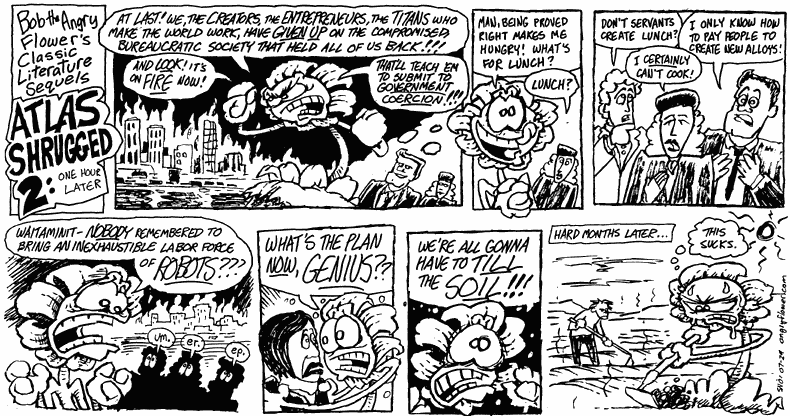
The punchline of that joke is completely invalid: in the novel, the tycoons do in fact grow their own food. But then again, why bother to read an actual book when you can form your opinions based on hearsay?
Yeah, that's the one. Interestingly enough, the back of my brain says the symbol on it has changed, and used to be the one found on http://blog.harjtaggar.com - which I now realize is supposed to be Superman with his cape flowing, but read before as 'some dude with a weird pointy head, I dunno, kinda looks like Jamaroquai's logo I guess'.
This seeming swap is surely, in part, the result of me not looking very closely at the logo. But it might also be a consequence of how de-emphasized the few touches of individuality are in the Svbtle scheme. I don't think "I'm at [author]'s site" when I hit one, I think "oh another Svtble site". It could probably even be fixed pretty easily by filling the whole sidebar with the color and having the white logo float in that, thus giving the brain an actual silhouette to parse out of the corner of my eye instead of 'uh it's a circle and there's something in it I dunno hey look at all this important text over here'.
Their blog ID system doesn't compensate for it. The single color icons with generic shapes don't register. They need a face or some fancy complex visual. And it needs to be large.
Obviously you don't have this problem on Google+ and Facebook, you know you're on a different user's profile each time because you find the face first.
But maybe they don't care. I personally don't care if I can't tell them apart because I'll only look at the ID if they write something that interests me and those chances are incredibly low.
Oh, cool. Consider my commentary in this thread as critique, not flames - it was really striking when it was just your personal brand, and if I didn't think the look and the content were both often interesting, I wouldn't have gone into as much detail!
Not the same. Bootstrap is very flexible and while there are copycats that are aping the Twitter layout instead of simply using the framework, it's like complaining all {Windows,OSX,Linux} apps have the same buttons.


The first appearance was cool, it was distinctive and unique. A breath of fresh air, even. But now it seems like a third of the links I hit from HN are Svbtlr blogs; it's starting to feel as generic and indistinguishable as last year's Wordpress theme.