I'm not usually for arguments of "this money could have been better spent elsewhere", but here's a thought experiment. Lets say instead of injecting $2 trillion and counting into a few AI companies, we instead injected $2 trillion dollars into things like infrastructure (real infrastructure, not GPU warehouses), education, helping out communities ravaged by globalization (I doubt most people on Hacker News venture outside of coastal areas, but if you want to make a REAL difference as an entrepreneur why not look at parts of the country that are struggling and figure out how you could make a difference there? You know, instead of trying to just ruin the economy for the sake of the already-obscenely-wealthy). I'm not saying all those ventures would succeed, but I think that amount of money put towards boring-but-real problems would make a much bigger positive impact for everyone.
You have to wait 20 years for the returns to society. Public education was enormously successful when it was introduced in the 19th century. There's just no profit in waiting for second order effects to kick in.
So was Rural Free Delivery. Farmers being able to communicate was a massive boon. There is a channel for farmers called RFD tv. They completely scrubbed the free provided by the government part after private equity bought the tv channel targeting farmers. Then they got Imus in the Morning so farmers listed to Imus, Rush, Hannity, and orielly forgetting the government helps them.
Diminishing returns. Per-student education spending has been going up since 1990 except a dip during the 2008 recession. Adjusting for inflations it’s now double what it was 30 years ago.
Well yes, you have to spend the money wisely. How could we construct a system so that we have 2x as many teachers (thereby halving the classroom size)? That would have a lot of good second-order effects beyond test scores.
So why has per-capita student spending doubled since 1990 (adjusted for inflation) without any increase in test scores? Why haven’t we been spending the money wisely?
> ...instead of injecting $2 trillion and counting into a few AI companies...
Similar to the "why we spend money exploring space when there are hungry people on Earth?" question, I don't think this is a This Or That argument.
People and companies have different interests, some don't/can't care about education etc so they don't invest in those fields. Forcing these people/companies to invest in areas they don't interested in usually results in bad outcomes that is way worse than just let them be.
But some, do invest in education or civil infrastructure projects. It's not as hot, because... well, usually it makes less money from those things.
The core problem is still that, it is hard to figure out how to invest in such way that it could help the disadvantaged people, while at the same time maintaining a 10 or even 100x growth in the next 5 years.
From the company's perspective, there's no dilemma here, it's 100x growth potential ahead of everything else.
> we instead injected $2 trillion dollars into things like infrastructure (real infrastructure, not GPU warehouses), education, helping out communities ravaged by globalization
Even excluding military spending, US governments spend $2 trillion every 10 weeks.
I wasn't making a judgment about including or not including state spending. It's just that "US governments" is not a common way for Americans to describe federal and state. People think federal when they see "US government".
You have to include state and local spending too. We’re at 40% of GDP which works out to almost $13 trillion: https://fred.stlouisfed.org/graph/?g=1CFpQ. Subtract $1 trillion in defense, and we’re spending about $1 trillion a month on government.
Does that chart double-count state transfers to municipalities? When I was in local government, about half our school budget came from the state, so there would be entries on both ledgers.
It all sounds great, but unfortunately human nature is that money attracts corruption, so how could a $2T injection be managed in a way that ensures everything is square, without adding significant overhead to the spending?
Governments are often just as bad at this as private entities are.
It won't make much difference. The US has a lot of problem, but "not spending enough money" isn't one.
The US government spend a lot on healthcare ($5.3 in 2024)[0]. More than most European countries per capita. But many people still feel that the US hardly has healthcare at all. Pouring more money without a full structural overhaul will likely make things worse.
And the $2T you mentioned is investors' money, which means that your plan is actually to increase tax by $2T and pour it into a system proven inefficient.
People invest in what would get them the highest ROI. No one is really thinking about “improving the world”* when they invest.
What’s scary about the AI boom is people over investing and not being able to recoup their investment which will lead to knock on effects - companies going bankrupt and people losing jobs, savings gone, … etc.
* As ESG has shown, not everyone agrees on what is considered “improving”.
I don't think we don't really know how to do many of these things you list even if we have infinite funds. There is a real chance that we will mess things even more if we have infinite funds...
Of course we do, we were doing them until about the mid-70s and then the ultra-wealthy figured out how to game the system and we got “Greed is Good” Geckos running things since.
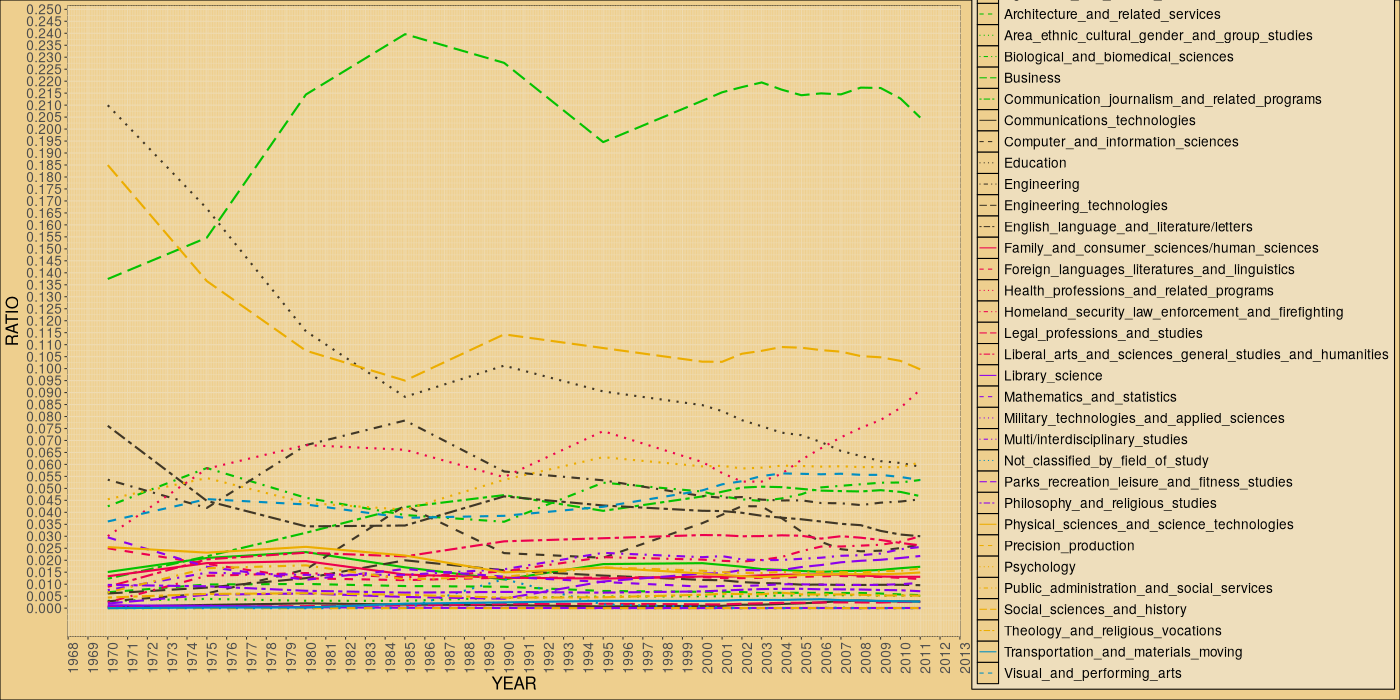
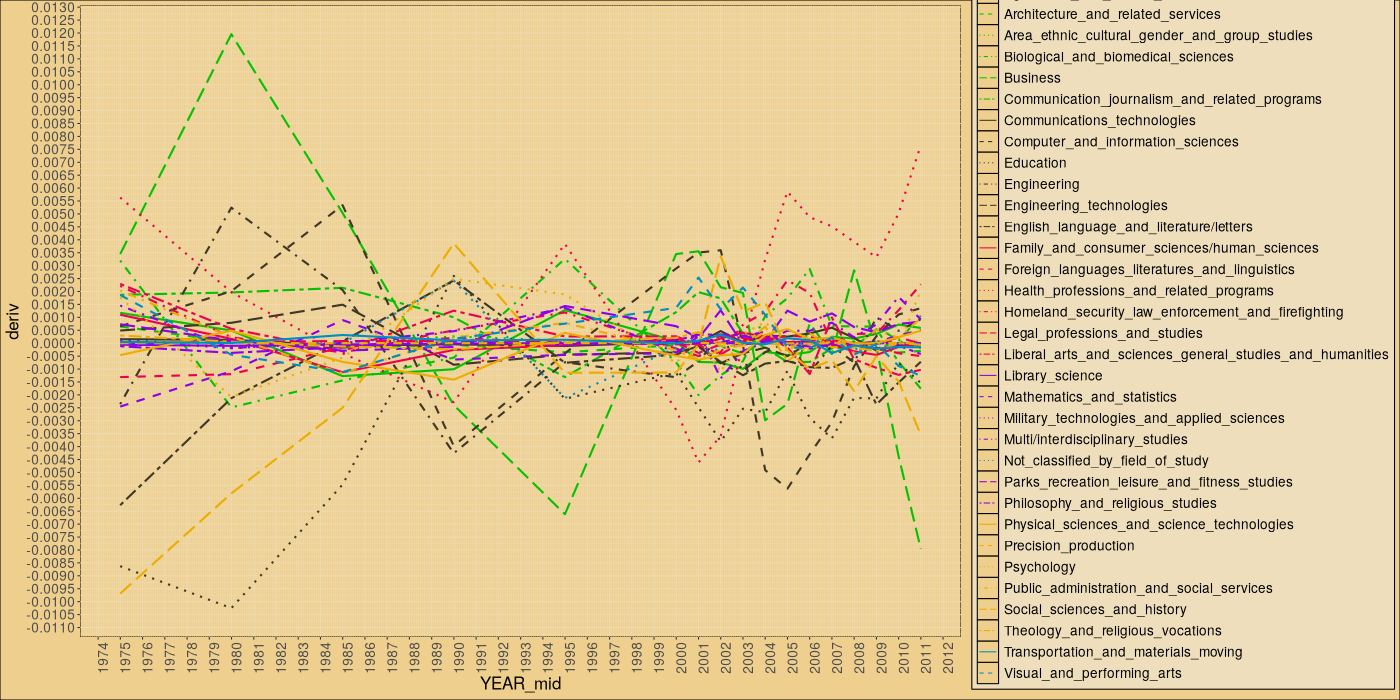
And, in case anyone needed proof, this is reflected in the US degree-completion-data, when measured as a percentage (https://galacticbeyond.com/two-percent-programmer/plots/over...), and when measured as a derivative of percentage (https://galacticbeyond.com/two-percent-programmer/plots/deri...). That green top-line, is business-majors, and those two lines that declined from top to average are social-sciences and education (all data from 1970 to 2011). In 1970 1 in 10 graduates were in business, 1 in 5 were in education and in social sciences. By 2011, 1 in 5 (or 2 in 10) were in business, and 1 in 10 were in social sciences and 1 in 20 were in education. Healthcare went from 3 in 100 to 1 in 10.
> and we got “Greed is Good” Geckos running things since
This phrase is the opposite of an exaggeration. It sounds like it should not be true, but it really, really is. To be fair though, if you told me in 2015 what the headlines for the 2020s would look like, I would assume you are some kind of satirist or comedian.
For context, the US alone spends annually a bit more than $2T on Social Security, Medicare, and Medicaid. That money is widely dispersed both geographically and socioeconomically. $2T is not as much as one may think. I think we should let investors put their private money where they wish.
Also, as an aside, the benefits of globalization on the balance far outweigh the drawbacks. Globalization has been the primary force pulling 3rd world countries out of poverty over the last 80 years.
“This is how the world should work” I say once I read that the handful of entities engineering global economic calamity are privately held. I interrupt my chat bot girlfriend’s detailed but deeply incorrect summary of yesterday’s news to type “Only a literal child would want to go to a school.” “That is so true! You’re really on to something brilliant there! To get a head start before we drill down on this further I’ve deleted the contacts group ‘School Friends’.”
I don’t know what she’s talking about. I’ve never had a contact group with that title. Out the window my car is doing donuts on an old baseball diamond.
China is showing the world how it's done. Check out how many nuclear reactors they have built in the last 10 years. Turns out having a government that plans long term and actually delivers what they said they would makes a huge difference.
Always loved this from The Big Short (movie):
"In the years that followed, hundreds of bankers and rating agency's executives went to jail. The SEC was completely overhauled, and Congress had no choice but to break up the big banks and regulate the mortgage and derivatives industries.
Just kidding.
Banks took the money the American people gave them, and they used it to pay themselves huge bonuses, and lobby the Congress to kill big reform. And then they blamed immigrants and poor people, and this time even teachers. And when all was said and done, only one single banker went to jail."
Edit: I see I'm not the first to quote The Big Short in reply - such a good movie (and book)!
Not this time. This time, we'll bail out them out because they are too big to fail and they need the money and assets. Next time we'll definitely get them. Pinky promise.
If it’s after the midterms, I’m doubtful. The AI leaders—apart from Dario—have gone particularly partisan. We also have a lot more post-crisis tooling that lets us wipe equity even when bailing out. See, for example, the ‘23 bank failures.
Even if one thinks we need to bail out the _companies_ to prevent more severe economic collapse, we could still arrest plenty of those who were in charge of these organizations.
>"I have a feeling in a few years people are going to be doing what they always do when the economy tanks. They will be blaming immigrants and poor people." -Mark Baum, The Big Short
The scapegoats for this plan never change and have never changed in human history.
Well assuming it's successful, there will be a large number of companies who's value will be reassessed as the token cost to replicate and run the business.
Multi-million dollar companies will be reduced into multi thousand dollar companies.
The CEOs will be replaced with teenagers in garages with their parent's credit cards.
If it stalls, then China will undercut the whole AI market with cheap electricity and crash the US stock market.
I can’t help but notice the “if it stalls” still assumes AI is successful, only that China beats the US. What if AI in general can’t do any of the things you mention?
It's obvious to more people every day that "AI" has never delivered on what it promised. Until now nobody cared because the costs were cheap and it pays to appear cutting edge. Now the price is rising, and the delayed cost of AI-addiction and broken outputs are starting to sting. Not that employers care about the individual harms of course, but a workforce so deep in collective delusion that they can't see the train coming is only useful when the market is delusional too.
Once this snaps, and it will snap suddenly, companies will be climbing over each other to rip out AI as fast as possible. They won't call it that, of course, you're not going to get a CEO on the news talking about how they made a mistake and it was wrong to invest so much in AI tech. But they'll mean it.
The win scenario is that the crash reduces "AI" use to near zero. Spat out into the graveyard of VC hype like blockchain and metaverse before it. Banished to an eternal unlife of scammers running call centre scams, deepfake porn producers, and the occasional "we made AI safe!" startup trying to reignite the bubble again. While companies with their business on the line clamber to announce that they don't use it.
no matter what, success or not the bubble is going to bust, it has inflated so much, the risk of it deflating slowly is a pipe dream. if AI doesn't turn into AGI, global financial crash. if AI turns into AGI and tons of people are out of work, global financial crash too.
Wishful thinking has it that we rally our representatives to let OpenAI and consorts rot. The last thing people should do is bail these delusional people out. Let them have it worse then WeWorks and let’s see if their self crowned AGI can help them out of their misery
We are 81 years away from the end of World War II. The baby boomers born after are the ripest target of financial sharks aiming to get a chunk of their retirements. People will be liquidating to settle estates, to pay inheritance taxes in large numbers. The AI boom feels like a stealthy rug-pull from other assets that are likely to tank from retirement withdrawals and into something that may last a little past the boomer assets wave.
Yes now that everyone’s equity is tied to overvalued assets, it’s a problem because it can have economy wide effects like in the subprime mortgage crisis.
Pretty much. Given the levels of investment in capital and research if AI companies actually hit what they're aiming at they'd have to collapse the labor market to recoup, bricking the economy in the process. Given the levels of outside investment inflating valuations, if the bubble pops it's 2008 all over again. There's this incredibly narrow window of "just useful enough to extract rents" where everything doesn't go to shit.
No, it's correct. The best (short-term) case is that they become eternal parasites. If they fail to do that, they'll bring a lot down with them when they fall.
>The best (short-term) case is that they become eternal parasites.
Producing a product that delivers value and people are willing to pay for makes you a "parasite"? Sure, it might cause massive disruptions to the labor market, but that's mostly orthogonal to whether it's a "parasite" or not. Mechanized farming has almost wiped out agricultural employment (compared to pre-industrial levels), but that doesn't make tractor manufacturers or fertilizer companies "parasites"
tractor manufacturers or fertilizer companies didn't suck down the work of generations of predecessors in a questionably-legal fashion only to turn around and sell a heavily discounted version of that back to them. I'm not sure where "parasite" becomes appropriate, but your analogy is poor.
Maybe in the eyes of seething artists/programmers seeing their jobs getting automated, but courts have so far ruled that AI training falls under fair use.
Moreover it's not hard to think of vaguely similar objections to fertilizers. They're often produced at some harm to society, as well as their use. They're also in some sense, a "heavily discounted" versions of that they replaced, bird guano or whatever.
> Moreover it's not hard to think of vaguely similar objections to fertilizers.
It's completely different. If LLM companies pulled this out of thin air it would be also different, but no; they've effectively plundered the commons and locked up all the profit for themselves. If intellectual labor goes the way of agricultural labor, I think humanity will have lost something valuable.
And don't come back with the "farmers would have said the same thing about the industrial revolution!" thing again if you're just going to terminate your thought there. Automating agricultural labor brings vast material benefits for all since it lowers the cost of tangible goods needed for life. I'd challenge you take this one step further and explain why automating intellectual labor will provide similar fruits and is therefore something to cheer for.
If we actually do meaningfully automate intellectual labor, we create a world where we have real technical solutions for our toughest problems. Maybe we can get carbon capture and fusion energy working. There’s a theoretical world of abundance for us to explore.
That’s the steel man argument.
FWIW I mostly don’t believe that LLMs are the answer, I don’t think they’re going to reach a high enough level of capability to do this, and I think the current AI companies are problematic in a lot of ways.
I also think LLM use is bad for us and probably harms our thinking abilities. And using it takes away a lot of what it means to be human.
Personally I like both physical and mental difficulty. I like gardening even if I could just buy mass produced flowers. I like riding a bike even though cars are “easier”. I like playing ukulele with my family even though I can barely make a chord, much better than listening to some other real musician, or Suno ai generated songs. I like eating my wife’s sourdough bagels even if they take several hours more than just buying some.
And I think having those regular challenges and achievements make life worth living! And I worry that the AI future that some envision will make much of what we get value from feel meaningless in the same way that writing code by hand is starting to.
Maybe we’ll still be fine in the same way I find meaning in all of those things that I listed above. But damn what a gamble
No, that's actually more destructive in the short term. That was the OP's point. If they actually become something effective, they will utterly destroy the economy. If they fail, they will drag the economy down around them as they go. The least destructive possible outcome is becoming eternal parasites.
Well there's also the fact that fundamentally and ultimately, AI is incompatible with the economic system. Capitalism is rooted in human labour having positive economic value, and hence demand. AI will ultimately automate all labour, making the economic value 0. Eventually capital generation will simply die and the system crashes.
Yeah but the investments arent aiming for churning out SaaS apps. Its to automate large swathes of intellectual labour. Of which only SWE has been cracked yet. There is a question mark as to if the others will crack. If they arent then these investments will collapse from speculation down to reality. That possibility is what is being discussed here
As to whether that will happen, I think that risk is real. Because claude code isnt made by the generalozed capabilities of the tech but by good old non-generalozable hueristics and rule based engines. I dont think that will scale to other feilds at the factor these investments assume. Its the bitter lesson again. It scales with deliberate and specific design, not data, so it wont scale
We learnt this with ibm watson. Deepblue achieved chess supremacy but the last mile wasnt data driven, it was heiristic driven, and so watson, its successor, couldnt scale/generalize.
My prediction is that this speculation on LLMs with harnesses will collapse since they wont scale. We'll have another winter where the reasearchers will be leaft alone long wnough to come up with the next breakthrough (probably game theory based data driven agency) which might then create what this hypecycle is speculating
There’s argument to be made that SWE hasn’t been cracked either. The latest models are great at coding medium sized applications, but figuring out the requirements and consolidation of domain knowledge is something still lacking
We will find out how much of work is given to people just so that there's a person/company associated with a technical decision. I personally think this might be quite high.
Exactly. I build automation tools for my company which have improved productivity quite a lot and put precisely zero people out of a job. Partly we find other things for them to spend time on, and partly it just turns out that we like to have humans doing jobs.
It is cliche at this point that HN is the place you go to hear software developers reduce all of the world's problems into simple algorithmic arguments which for some reason never actually solve anything. Not shocked that we are similarly incapable of understanding that algorithmically replacing a software developer isn't easy just because we think we know what the job is.
you mentioned a very good point about scalability. we're seeing alot of productivity gains, but only from SWEs, which are but a very small segment of the global economy. all other economic use cases require thorough last-mile development and iteration that is not too different with current automation tools.
A friend who is a psychologist was telling me he thinks in another year or two insurance companies will insist people see an AI therapist first before being willing to pay for a real person.
Tracks. This is that same speculation that AI will be good enough. Wonder what a crash in that isecase will look like? Increased suicide rates? More instances of psychosis? It might not wven be directly measurable or easily traceable to AI therapists. Would suck
LOL, the same AI that has landed companies in court defending themselves against wrongful death lawsuits for helping someone convince themselves suicide is the right answer, and even encouraging them? That AI? I am unclear that any insurance company is going to want a piece of that action anytime soon.
What you've just told me is that psychologists, just like SWEs, are prone to thinking they know how business works but in fact know fuck all.
All those automaton tools will eventually be initially one-shotted and then monitored by LLMs though. There probably won't be a "last mile" per se; just constant tweaking and optimizations throughout, within a feedback loop.
We aren't seeing productivity gains in software either. What we are seeing is a lot of people who claim to be more productive, but in fact are building piles of tech debt that will fall over before long. But hey, they're building that tech debt really fast!
While I don't agree with your premise at all, even if it could one shot a SaaS product (a statement so vague it's meaningless) I don't think there's much of an argument for why that's economically useful. A lot of SaaS has free software/open source equivalents anyway (how else do you think the clanker's are able to plagiarize it?). People still pay for Office even though you could easily use LibreOffice, or GitHub when you could self host Forgejo. It's like when anthropic made a big deal out of making a broken compiler. Neat, so, after ingesting all of open source and burning a trillion tokens you ended up with something worse than what's already out there; and instead of doing something economically useful like giving a person money to build it or supporting the open source ecosystem, you're just wasting energy on datacenters.
So good at it that I’m right now in the process of building instead of buying.
Here’s how that plays out in the economy:
- My company spent $50 on my tokens to build this internal tool
- Anthropic spent $XXX to deliver those tokens to me.
- The company I was going to buy the tool from lost $XX,XXX per year that I would have paid them.
I dunno, kind of sounds like the economy just got smaller.
I could usually accept the idea that software getting cheaper generally increases demand for software and expands the economy surrounding it, but I’m not sure if we have precedent for what happens when software becomes positively worthless.
I certainly can’t give you a better answer for my company than “it depends” or “I don’t really know.”
The company could just be happy to have better margins and be happy the stock finally went up. It might literally do nothing with them or do something economically unproductive like buy back stock.
What I can tell you with certainty is that we aren’t going to hire anyone else or launch any other product as a result. Our business just isn’t at that level of growth potential.
Perhaps we can surmise that money going to shareholders can grow the economy. They’ve got more money to reinvest in other stuff.
But then again, if everyone can shart out a SaaS app with $50 in tokens, what software companies will they want to invest in?
AI gives me that feeling of “what happens to bakers and butchers when the supermarket gets invented and they decide to sell bread and meat at or below cost?”
Every company has a list of >WACC IRR projects that it can spend saved money on. If not, it’s a cash cow company that wasn’t growing in the first place and will allow shareholders to use the saved cash for other economically expanding projects.
What companies can expand if the income of consumers is shrinking. This is the scary bit to me — AI crashes and takes the economy with it, or; AI succeeds as promised and people go unemployed and crash the economy.
The only path that isn’t disastrous is threading the needle of “just right” productivity gains. The people in charge aren’t smart enough to give me warm fuzzy feelings on that.
Economy != software companies. Maybe there needs to be a capital rotation out of tech? That’s speaking beyond my expertise though (and imo is a little too doomer). Continuing the hypothetical through: Healthcare, industrials, financial services and many other verticals have plenty of growth opportunities.
Otherwise it would probably be the software companies that are the most focused on last-mile details (where AI in my experience has the most trouble). I expect that as consumers are faced with more and more AI slop SaaS they will be increasingly willing and able to pay for quality.
And if the company didn't need $XX,XXX*0.90 (or more) that you would have paid them to further develop their product and stay in business? If that other company now paid their own $50 in tokens? Maybe the overall flow of money in the economy went from $XX,XXX (you) + $XX,XXX (them) + $(not much, AI didn't exist yet) equals or is greater to $50 + $50 + ($xbillions in AI)? Dunno.
wouldn't take long for them to find out with the developer bragging about it. he one-shot vibe-coded a sass app (keyword: one-shot), that says alot about the quality.
> Meanwhile AI has gotten so good it can just about one shot a SaaS app.
There isn't a direct correlation between AI improvement or stagnation and whether or not the amount being spent by AI labs and the associated ecosystem will result in a financial crash.
Look into the history of railroads and the internet itself to see how massive levels of investment can result in economic crashes even when the thing being invested in produces real, widespread societal value.
One could argue that one of the nightmare economic scenarios for AI is actually that it gets too good too fast and results in a wipeout of the white collar worker that we are currently nowhere near ready to deal with given how propped up our economy is on consumer spending.
difference this time is they have "fiat money" and money printer. Market and all inv. bankers knows that in major crash they will print unlimited amounts so back to same prices or near them. printer is still printing and it's only goes to selected investments
As if they did not back then. Fiat is just simpler to work with, but one can pull a bubble without it just fine. Anyone forgot the railroad crash of 1873? The tulip mania of 17th century?


reply